Running a small business requires managing many different responsibilities. Business owners may need to handle customer communication, marketing, content creation, bookkeeping, project management, sales, scheduling, and daily administrative tasks.
Artificial intelligence is helping small businesses manage these responsibilities more efficiently. AI tools can assist with writing, research, customer support, marketing, organization, data analysis, and automation.
In 2026, small businesses have access to a wide range of AI-powered tools. Many of these tools can help business owners save time and improve workflows without requiring a large team.
The key is to choose tools that solve real business problems and fit naturally into existing workflows.
In this guide, we will explore some of the best AI tools for small businesses in 2026 and explain how they can be used.
Why Small Businesses Need AI Tools
Large companies often have dedicated teams for marketing, customer service, design, research, and administration. Small businesses usually operate with fewer employees, which means one person may have to handle several responsibilities.
AI can help reduce some of this workload.
For example, an AI writing tool can help create an email draft, while an AI design platform can assist with social media graphics. A project management tool can help organize tasks, and an automation platform can connect different applications.
AI does not have to replace employees. Instead, it can help people complete repetitive tasks more quickly and spend more time on work that requires human judgment.
1. ChatGPT
ChatGPT can be useful for many small business activities because it can assist with writing, brainstorming, research, planning, customer communication, and content creation.
A business owner can use it to brainstorm marketing ideas, create social media content, prepare email drafts, develop product descriptions, or organize a business plan.
For example, a small online store could provide basic product information and ask AI to create several versions of a product description. The owner can then review and personalize the final copy.
Small businesses can use ChatGPT for:
- Business brainstorming
- Email writing
- Social media ideas
- Product descriptions
- Marketing copy
- Customer response drafts
- Content planning
- Research assistance
- Meeting preparation
- Business documentation
It can act as a general-purpose assistant for many everyday tasks.
2. Microsoft Copilot
Microsoft Copilot can be useful for businesses that already use Microsoft products.
Depending on the available plan and features, AI assistance can support workflows involving applications such as Word, Excel, and PowerPoint.
Business owners can use AI to help draft documents, summarize information, analyze data, and prepare presentations.
For example, a small business owner could use AI assistance to turn information from a business report into a presentation outline.
This can reduce the amount of time spent on routine document and office tasks.
3. Google Gemini
Google Gemini can assist small businesses with brainstorming, writing, summarization, research, and other productivity tasks.
Businesses already using Google’s ecosystem may find AI assistance useful for workflows involving documents and other Google services, depending on available features.
A business owner could use Gemini to brainstorm campaign ideas, summarize notes, prepare drafts, or organize information.
As with any AI assistant, important business information should be reviewed before it is used in customer-facing or financial decisions.
4. Canva
Visual marketing is important for small businesses.
Canva provides design tools and AI-powered features that can help businesses create social media posts, advertisements, presentations, flyers, product graphics, and other marketing materials.
A small business does not always have the budget to hire a professional designer for every visual task.
With templates and AI-assisted design features, business owners can create visual content more efficiently.
Canva can help create:
- Social media graphics
- Business presentations
- Advertisements
- Flyers
- Posters
- Product images
- Marketing materials
- Social media banners
Consistent branding should still be maintained across all business visuals.
5. Grammarly
Clear communication is important for every business.
Grammarly can help improve grammar, spelling, clarity, tone, and readability in business writing.
Small businesses can use writing assistance for emails, website content, proposals, reports, social media posts, and marketing materials.
For example, before sending an important client email, a business owner can review the message with an AI writing assistant to identify unclear sentences or grammatical mistakes.
This can help businesses communicate more professionally.
6. Notion AI
Notion can help small businesses organize information, projects, notes, and internal documentation.
AI features can assist with summarizing information, generating content, brainstorming, and organizing knowledge.
A small business can create a central workspace for:
- Business procedures
- Project information
- Meeting notes
- Content calendars
- Marketing ideas
- Product information
- Team documentation
- Task lists
Having information in one organized location can make collaboration easier, particularly when employees work remotely.
7. ClickUp
ClickUp is a project management platform that includes AI-powered features.
Small businesses can use project management software to organize tasks, deadlines, projects, and team responsibilities.
AI assistance can support writing, summarization, task-related workflows, and project organization.
For example, a marketing team can divide a campaign into individual tasks such as research, content creation, design, review, and publishing.
This makes it easier for team members to understand their responsibilities.
8. Perplexity
Research is important for small businesses that need to understand markets, customers, competitors, and industry trends.
Perplexity can help users explore topics and gather information through an AI-powered research experience.
A business owner might use it to explore a new industry, investigate customer questions, or generate ideas for further research.
However, business owners should verify important facts and statistics using reliable sources before making major business decisions.
AI can accelerate research, but it should not be treated as the only source of truth.
9. Zapier
Automation can be especially valuable for small businesses.
Zapier connects different applications and allows businesses to automate repetitive workflows.
For example, a business might create a workflow where a new form submission triggers an action in another application.
Automation can be used for tasks involving:
- Lead management
- Email workflows
- Customer information
- Notifications
- Data transfer
- Task creation
- Marketing processes
- Administrative work
AI-powered automation can make workflows more flexible by helping businesses create processes using natural-language instructions and intelligent actions.
The result can be less manual work and more consistent processes.
10. HubSpot
HubSpot provides tools for marketing, sales, customer relationship management, and customer service, with AI features available across parts of its platform.
For a small business, keeping track of customer interactions can become difficult as the company grows.
A CRM system can help organize contacts, leads, conversations, and sales activities.
AI features can assist with tasks such as content creation, summarization, customer communication, and other business workflows, depending on the available product and plan.
11. QuickBooks
Financial management is one of the most important areas for a small business.
QuickBooks provides accounting and financial management software with automation and AI-related features that can assist with financial workflows, depending on the product and plan.
Businesses can use accounting software to organize transactions, invoices, expenses, and financial information.
Automation can reduce some manual bookkeeping work, but financial records should still be reviewed carefully.
For important tax, accounting, or financial decisions, businesses should consult an appropriately qualified professional.
12. Otter.ai
Meetings and customer conversations can contain important information.
Otter.ai can help transcribe spoken conversations and create written records that can be reviewed later.
Small businesses can use transcription tools for:
- Team meetings
- Client calls
- Interviews
- Research conversations
- Planning sessions
- Business discussions
Instead of relying entirely on handwritten notes, teams can use transcripts as a reference.
Businesses should make sure that recording and transcription comply with applicable laws, company policies, and participant consent requirements.
Best AI Tools for Different Small Business Tasks
The right AI tools depend on the type of work your business performs.
For Marketing
Useful tools include:
- ChatGPT
- Canva
- Grammarly
- HubSpot
These can support content creation, marketing ideas, design, and customer communication.
For Productivity
Consider:
- ChatGPT
- Microsoft Copilot
- Google Gemini
- Notion AI
- ClickUp
These tools can help with planning, documents, organization, and task management.
For Research
Useful options include:
- Perplexity
- ChatGPT
- Google Gemini
Use AI research tools as starting points and verify important information.
For Automation
Zapier can help connect applications and automate repetitive processes.
For Meetings
Otter.ai and other meeting-related AI tools can assist with transcription and summaries.
How AI Can Help Small Businesses Save Time
Small businesses often have many repetitive tasks.
Employees may repeatedly write similar emails, update spreadsheets, create reports, schedule activities, transfer information between applications, or prepare social media posts.
AI and automation can reduce some of this repetitive work.
For example, instead of starting every marketing email from a blank page, a business can use AI to create an initial draft. Employees can then review, edit, and personalize it.
Similarly, automation can move information between connected applications without requiring someone to perform the same manual steps repeatedly.
Small improvements across multiple workflows can produce significant time savings over the course of a week.
AI for Small Business Marketing
Marketing is an area where AI can provide useful support.
A small business can use AI to brainstorm campaign ideas, create content outlines, draft captions, generate visual concepts, and analyze customer questions.
For example, a local business could create a monthly content plan around frequently asked customer questions.
AI can generate initial ideas, while the business owner adds local knowledge, real experiences, promotions, and brand personality.
This combination can make content creation more efficient while keeping the business’s identity intact.
AI for Customer Service
Customer service is another area where AI can provide assistance.
AI can help businesses draft responses to common questions and organize support information.
For businesses with repetitive customer inquiries, a well-designed knowledge base combined with appropriate AI assistance can help employees find answers more quickly.
However, customers should have a clear way to reach a human when a problem is complex, sensitive, or outside the AI system’s capabilities.
Human oversight remains important for complaints, refunds, unusual requests, and other situations requiring judgment.
AI for Small Business Content Creation
Content marketing can be difficult when a small business has limited resources.
AI can help generate ideas for:
- Blog posts
- Social media content
- Newsletters
- Product descriptions
- Video scripts
- Advertisements
- Educational content
However, businesses should add original information, real examples, expert knowledge, and brand personality.
AI-generated content should be reviewed for accuracy and originality before publication.
Important AI Considerations for Small Businesses
AI tools can provide significant benefits, but businesses should consider several risks.
Protect Business Data
Avoid putting sensitive customer, employee, financial, or confidential business information into AI tools unless the service and business policy permit it.
Review AI Output
AI can produce incorrect information. Important business documents, customer communications, financial information, and factual claims should be checked.
Check Pricing
Some AI tools offer free versions, while advanced features may require paid subscriptions.
Businesses should calculate whether a tool provides enough value to justify its cost.
Understand Privacy
Before using an AI service for business information, review its privacy, data handling, and security practices.
Train Employees
If employees use AI, establish simple guidelines explaining what information can be entered into AI systems and what requires human review.
How to Choose the Right AI Tools
Choosing AI tools does not have to be complicated.
>Start with your biggest business problem.\
If your team spends too much time writing, consider an AI writing assistant.
>If your business struggles with organization, consider project management or knowledge-management software.
>If repetitive administrative tasks consume time, look at automation tools.
>If marketing design is a challenge, an AI-powered design platform may help.
You should also consider:
- Cost
- Ease of use
- Integrations
- Security
- Privacy
- Scalability
- Customer support
- Team requirements
A small collection of useful tools is often easier to manage than dozens of separate applications.
Simple AI Workflow for Small Businesses
A small business can create a simple AI-supported workflow:
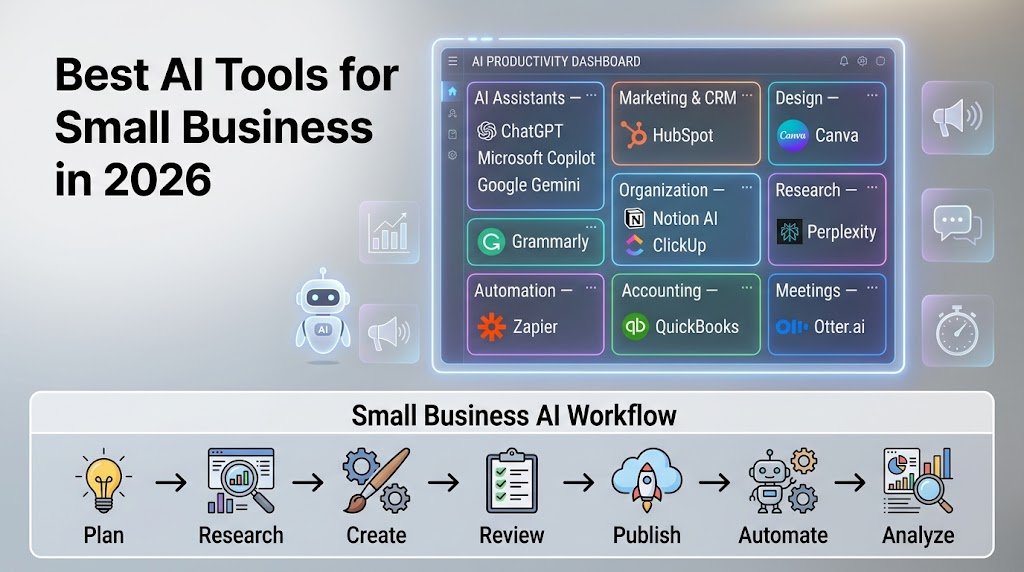
Plan → Research → Create → Review → Publish → Automate → Analyze
First, identify business goals and priorities.
Then use AI to support research and brainstorming.
Create the content or complete the task.
Review the AI-assisted output carefully.
Publish or deliver the final work.
Automate repetitive steps where appropriate.
Finally, analyze the results and improve the process.
This keeps AI connected to actual business goals rather than using technology simply because it is available.
Final Thoughts
AI tools are becoming increasingly useful for small businesses in 2026. They can support marketing, writing, research, customer communication, project management, meetings, financial workflows, design, and automation.
Tools such as ChatGPT, Microsoft Copilot, Google Gemini, Canva, Grammarly, Notion AI, ClickUp, Perplexity, Zapier, HubSpot, QuickBooks, and Otter.ai can each support different areas of a small business workflow.
The most important step is to identify tasks that consume unnecessary time and determine whether AI can make them simpler.
AI works best when combined with human experience, careful review, strong security practices, and clear business goals.
For small businesses, the goal should not be to automate everything. The goal is to use AI where it provides practical value while keeping people responsible for important decisions and final results.
Running a small business requires managing many different responsibilities. Business owners may need to handle customer communication, marketing, content creation, bookkeeping, project management, sales, scheduling, and daily administrative tasks.
Artificial intelligence is helping small businesses manage these responsibilities more efficiently. AI tools can assist with writing, research, customer support, marketing, organization, data analysis, and automation.
In 2026, small businesses have access to a wide range of AI-powered tools. Many of these tools can help business owners save time and improve workflows without requiring a large team.
The key is to choose tools that solve real business problems and fit naturally into existing workflows.
In this guide, we will explore some of the best AI tools for small businesses in 2026 and explain how they can be used.
Why Small Businesses Need AI Tools
Large companies often have dedicated teams for marketing, customer service, design, research, and administration. Small businesses usually operate with fewer employees, which means one person may have to handle several responsibilities.
AI can help reduce some of this workload.
For example, an AI writing tool can help create an email draft, while an AI design platform can assist with social media graphics. A project management tool can help organize tasks, and an automation platform can connect different applications.
AI does not have to replace employees. Instead, it can help people complete repetitive tasks more quickly and spend more time on work that requires human judgment.
1. ChatGPT
ChatGPT can be useful for many small business activities because it can assist with writing, brainstorming, research, planning, customer communication, and content creation.
A business owner can use it to brainstorm marketing ideas, create social media content, prepare email drafts, develop product descriptions, or organize a business plan.
For example, a small online store could provide basic product information and ask AI to create several versions of a product description. The owner can then review and personalize the final copy.
Small businesses can use ChatGPT for:
- Business brainstorming
- Email writing
- Social media ideas
- Product descriptions
- Marketing copy
- Customer response drafts
- Content planning
- Research assistance
- Meeting preparation
- Business documentation
It can act as a general-purpose assistant for many everyday tasks.
2. Microsoft Copilot
Microsoft Copilot can be useful for businesses that already use Microsoft products.
Depending on the available plan and features, AI assistance can support workflows involving applications such as Word, Excel, and PowerPoint.
Business owners can use AI to help draft documents, summarize information, analyze data, and prepare presentations.
For example, a small business owner could use AI assistance to turn information from a business report into a presentation outline.
This can reduce the amount of time spent on routine document and office tasks.
3. Google Gemini
Google Gemini can assist small businesses with brainstorming, writing, summarization, research, and other productivity tasks.
Businesses already using Google’s ecosystem may find AI assistance useful for workflows involving documents and other Google services, depending on available features.
A business owner could use Gemini to brainstorm campaign ideas, summarize notes, prepare drafts, or organize information.
As with any AI assistant, important business information should be reviewed before it is used in customer-facing or financial decisions.
4. Canva
Visual marketing is important for small businesses.
Canva provides design tools and AI-powered features that can help businesses create social media posts, advertisements, presentations, flyers, product graphics, and other marketing materials.
A small business does not always have the budget to hire a professional designer for every visual task.
With templates and AI-assisted design features, business owners can create visual content more efficiently.
Canva can help create:
- Social media graphics
- Business presentations
- Advertisements
- Flyers
- Posters
- Product images
- Marketing materials
- Social media banners
Consistent branding should still be maintained across all business visuals.
5. Grammarly
Clear communication is important for every business.
Grammarly can help improve grammar, spelling, clarity, tone, and readability in business writing.
Small businesses can use writing assistance for emails, website content, proposals, reports, social media posts, and marketing materials.
For example, before sending an important client email, a business owner can review the message with an AI writing assistant to identify unclear sentences or grammatical mistakes.
This can help businesses communicate more professionally.
6. Notion AI
Notion can help small businesses organize information, projects, notes, and internal documentation.
AI features can assist with summarizing information, generating content, brainstorming, and organizing knowledge.
A small business can create a central workspace for:
- Business procedures
- Project information
- Meeting notes
- Content calendars
- Marketing ideas
- Product information
- Team documentation
- Task lists
Having information in one organized location can make collaboration easier, particularly when employees work remotely.
7. ClickUp
ClickUp is a project management platform that includes AI-powered features.
Small businesses can use project management software to organize tasks, deadlines, projects, and team responsibilities.
AI assistance can support writing, summarization, task-related workflows, and project organization.
For example, a marketing team can divide a campaign into individual tasks such as research, content creation, design, review, and publishing.
This makes it easier for team members to understand their responsibilities.
8. Perplexity
Research is important for small businesses that need to understand markets, customers, competitors, and industry trends.
Perplexity can help users explore topics and gather information through an AI-powered research experience.
A business owner might use it to explore a new industry, investigate customer questions, or generate ideas for further research.
However, business owners should verify important facts and statistics using reliable sources before making major business decisions.
AI can accelerate research, but it should not be treated as the only source of truth.
9. Zapier
Automation can be especially valuable for small businesses.
Zapier connects different applications and allows businesses to automate repetitive workflows.
For example, a business might create a workflow where a new form submission triggers an action in another application.
Automation can be used for tasks involving:
- Lead management
- Email workflows
- Customer information
- Notifications
- Data transfer
- Task creation
- Marketing processes
- Administrative work
AI-powered automation can make workflows more flexible by helping businesses create processes using natural-language instructions and intelligent actions.
The result can be less manual work and more consistent processes.
10. HubSpot
HubSpot provides tools for marketing, sales, customer relationship management, and customer service, with AI features available across parts of its platform.
For a small business, keeping track of customer interactions can become difficult as the company grows.
A CRM system can help organize contacts, leads, conversations, and sales activities.
AI features can assist with tasks such as content creation, summarization, customer communication, and other business workflows, depending on the available product and plan.
11. QuickBooks
Financial management is one of the most important areas for a small business.
QuickBooks provides accounting and financial management software with automation and AI-related features that can assist with financial workflows, depending on the product and plan.
Businesses can use accounting software to organize transactions, invoices, expenses, and financial information.
Automation can reduce some manual bookkeeping work, but financial records should still be reviewed carefully.
For important tax, accounting, or financial decisions, businesses should consult an appropriately qualified professional.
12. Otter.ai
Meetings and customer conversations can contain important information.
Otter.ai can help transcribe spoken conversations and create written records that can be reviewed later.
Small businesses can use transcription tools for:
- Team meetings
- Client calls
- Interviews
- Research conversations
- Planning sessions
- Business discussions
Instead of relying entirely on handwritten notes, teams can use transcripts as a reference.
Businesses should make sure that recording and transcription comply with applicable laws, company policies, and participant consent requirements.
Best AI Tools for Different Small Business Tasks
The right AI tools depend on the type of work your business performs.
For Marketing
Useful tools include:
- ChatGPT
- Canva
- Grammarly
- HubSpot
These can support content creation, marketing ideas, design, and customer communication.
For Productivity
Consider:
- ChatGPT
- Microsoft Copilot
- Google Gemini
- Notion AI
- ClickUp
These tools can help with planning, documents, organization, and task management.
For Research
Useful options include:
- Perplexity
- ChatGPT
- Google Gemini
Use AI research tools as starting points and verify important information.
For Automation
Zapier can help connect applications and automate repetitive processes.
For Meetings
Otter.ai and other meeting-related AI tools can assist with transcription and summaries.
How AI Can Help Small Businesses Save Time
Small businesses often have many repetitive tasks.
Employees may repeatedly write similar emails, update spreadsheets, create reports, schedule activities, transfer information between applications, or prepare social media posts.
AI and automation can reduce some of this repetitive work.
For example, instead of starting every marketing email from a blank page, a business can use AI to create an initial draft. Employees can then review, edit, and personalize it.
lass=”yoast-text-mark” />>Similarly, automation can move information between connected applications without requiring someone to perform the same manual steps repeatedly.
Small improvements across multiple workflows can produce significant time savings over the course of a week.
AI for Small Business Marketing
Marketing is an area where AI can provide useful support.
A small business can use AI to brainstorm campaign ideas, create content outlines, draft captions, generate visual concepts, and analyze customer questions.
For example, a local business could create a monthly content plan around frequently asked customer questions.
AI can generate initial ideas, while the business owner adds local knowledge, real experiences, promotions, and brand personality.
This combination can make content creation more efficient while keeping the business’s identity intact.
AI for Customer Service
Customer service is another area where AI can provide assistance.
AI can help businesses draft responses to common questions and organize support information.
For businesses with repetitive customer inquiries, a well-designed knowledge base combined with appropriate AI assistance can help employees find answers more quickly.
However, customers should have a clear way to reach a human when a problem is complex, sensitive, or outside the AI system’s capabilities.
Human oversight remains important for complaints, refunds, unusual requests, and other situations requiring judgment.
AI for Small Business Content Creation
Content marketing can be difficult when a small business has limited resources.
AI can help generate ideas for:
- Blog posts
- Social media content
- Newsletters
- Product descriptions
- Video scripts
- Advertisements
- Educational content
However, businesses should add original information, real examples, expert knowledge, and brand personality.
AI-generated content should be reviewed for accuracy and originality before publication.
Important AI Considerations for Small Businesses
AI tools can provide significant benefits, but businesses should consider several risks.
Protect Business Data
Avoid putting sensitive customer, employee, financial, or confidential business information into AI tools unless the service and business policy permit it.
Review AI Output
AI can produce incorrect information. Important business documents, customer communications, financial information, and factual claims should be checked.</p>
Check Pricing
Some AI tools offer free versions, while advanced features may
require paid subscriptions.
Businesses should calculate whether a tool provides enough value to justify its cost.
<h3>Understand Privacy
Before using an AI service for business information, review its privacy, data handl
ing, and security practices.</p>
Train Employees
If employees use AI, establish simple guidelines explaining what information can be entered into AI systems and
what requires human review.
How to Choose the Right AI Tools
Choosing AI tools does not have to be complicated.
Start with your biggest business problem.
>If your team spends too much time writing, consider an AI writing assistant.
>If your business struggles with organization, consider project management or knowledge-management software.
>If repetitive administrative tasks consume time, look at automation tools.
>If marketing design is a challenge, an AI-powered design platform may help.
You should also consider:
- Cost
- Ease of use
- Integrations
- Security
- Privacy
- Scalability
- Customer support
- Team requirements
A small collection of useful tools is often easier to manage than dozens of separate applications.
Simple AI Workflow for Small Businesses
A small business can create a simple AI-supported workflow:
Plan → Research → Create → Review → Publish → Automate → Analyze
First, identify business goals and priorities.
Then use AI to support research and brainstorming.
Create the content or complete the task.
Review the AI-assisted output carefully.
Publish or deliver the final work.
Automate repetitive steps where appropriate.
Finally, analyze the results and improve the process.
This keeps AI connected to actual business goals rather than using technology simply because it is available.
Final Thoughts
AI tools are becoming increasingly useful for small businesses in 2026. They can support marketing, writing, research, customer communication, project management, meetings, financial workflows, design, and automation.
>Tools such as ChatGPT, Microsoft Copilot, Google Gemini, Canva, Grammarly, Notion AI, ClickUp, Perplexity, Zapier, HubSpot, QuickBooks, and Otter.ai can each support different areas of a small business workflow.
>The most important step is to identify tasks that consume unnecessary time and determine whether AI can make them simpler.
>AI works best when combined with human experience, careful review, strong security practices, and clear business goals.
For small businesses, the goal should not be to automate everything. The goal is to use AI where it provides practical value while keeping people responsible for important decisions and final results.