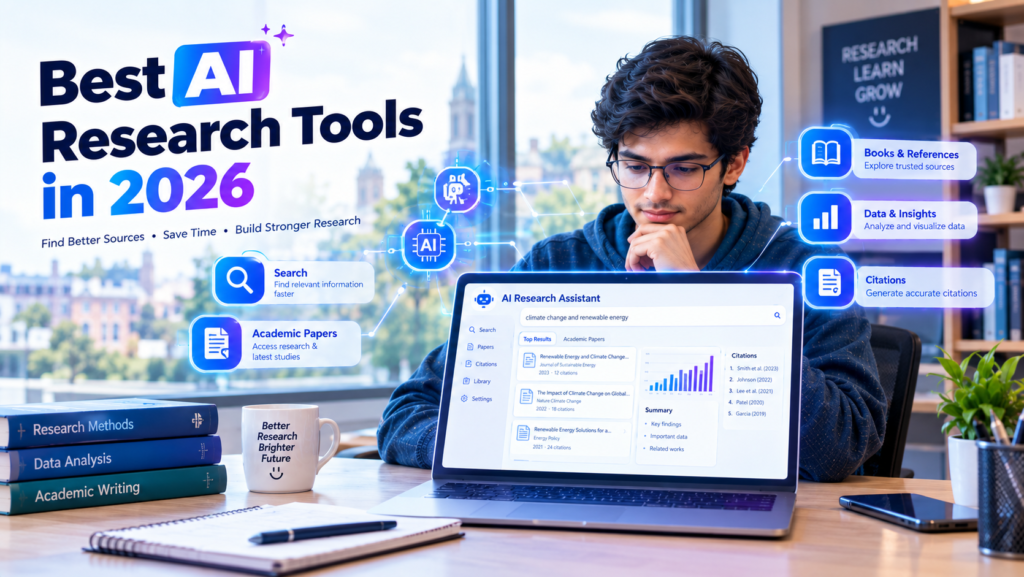
Research is an important part of education, business, content creation, and professional work. Whether you are a student searching for academic information, a blogger researching a new topic, or a professional analyzing industry information, finding reliable information can take a lot of time.
In 2026, AI-powered research tools are making this process faster and more organized. These tools can help users discover information, summarize documents, find research papers, compare sources, generate questions, and organize important findings.
However, AI should be used as a research assistant rather than a replacement for critical thinking. Important information should always be checked against reliable and original sources.
In this guide, we will look at some of the best AI research tools in 2026 and explain how they can help students, researchers, writers, and professionals.
What Are AI Research Tools?
AI research tools are applications that use artificial intelligence to help users find, understand, analyze, and organize information.
Traditional research often requires searching through many websites, articles, documents, and academic papers. AI tools can make some of these tasks easier by helping users identify relevant information and summarize large amounts of text.
Depending on the tool, AI research software can help with:
- Finding relevant information
- Searching for research papers
- Summarizing articles
- Understanding complex topics
- Analyzing documents
- Finding related studies
- Generating research questions
- Organizing notes
- Comparing information
- Creating research outlines
The features vary between platforms, so choosing the right tool depends on your specific research needs.
Why Use AI for Research in 2026?
AI research tools can improve the research process in several ways.
1. Save Research Time
Searching manually through hundreds of pages can take hours. AI tools can help identify potentially relevant information more quickly.
2. Understand Complex Information
Some AI assistants can explain difficult concepts in simpler language, making technical or academic information easier to understand.
3. Summarize Long Documents
Instead of reading a long document just to understand its main points, AI can help create a shorter summary.
4. Discover Related Information
AI-powered search systems can help users find related topics, papers, and sources that they may not discover through a simple keyword search.
5. Organize Research
Some platforms can help organize notes, documents, references, and research findings in one workspace.
Best AI Research Tools in 2026
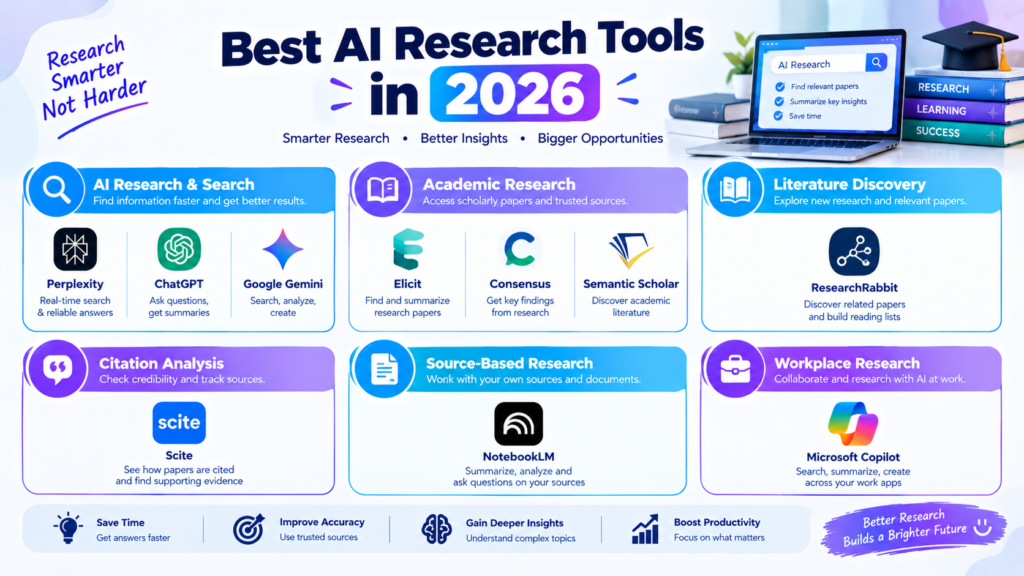
Here are some AI research tools that can be useful for different research tasks.
1. Perplexity
Perplexity is an AI-powered search and answer platform that can help users research topics using conversational queries.
Instead of simply providing a traditional list of search results, it can provide summarized answers along with sources that users can inspect.
It can be useful for:
- General research
- Topic exploration
- Finding sources
- Quick fact-checking
- Understanding unfamiliar subjects
When using it for important research, users should open and review the cited sources rather than relying only on the generated answer.
2. ChatGPT
ChatGPT can be used as a flexible research assistant. It can help users brainstorm research questions, understand concepts, organize information, summarize text, and create research outlines.
For example, a student researching climate change could ask for:
- Important subtopics
- Research questions
- Key concepts to understand
- An outline for a research project
- Questions to investigate further
ChatGPT can also help analyze information supplied by the user.
However, when factual accuracy is important, users should verify claims using trustworthy primary or authoritative sources.
3. Google Gemini
Google Gemini can assist with research, brainstorming, summarization, and understanding information.
It can be useful when you want to explore a topic from different angles or turn complicated information into a simpler explanation.
For example, students can use it to understand difficult concepts, while professionals can use it to brainstorm ideas or organize research notes.
As with other AI systems, generated information should be reviewed before being used as a factual source.
4. Elicit
Elicit is designed specifically to support research workflows. It can help users discover and analyze academic papers and extract useful information from research literature.
It can be especially useful for:
- Literature reviews
- Finding academic papers
- Comparing studies
- Extracting information
- Exploring research questions
Students and researchers working with academic literature may find specialized research platforms more useful than general-purpose AI assistants.
5. Consensus
Consensus focuses on research-based answers and academic literature. It can help users explore questions by searching research papers and presenting information related to scientific studies.
It can be useful when you want to understand what existing research says about a particular question.
For academic work, it is still important to examine the original papers and understand their methodology, limitations, and context.
6. Semantic Scholar
Semantic Scholar is an academic research platform designed to help users discover scientific literature.
It can help researchers find relevant papers and explore connections between academic publications.
Researchers can use it to:
- Discover papers
- Explore research topics
- Find related studies
- Review academic literature
- Follow important research areas
It can be particularly useful for students and researchers working on academic projects.
7. ResearchRabbit
ResearchRabbit is designed to help researchers explore academic literature and discover connections between papers and authors.
Instead of simply searching for one paper at a time, researchers can use literature connections to discover additional relevant studies.
This can be useful when building a literature review or exploring a research field.
8. Scite
Scite is a research platform that can help users examine how scientific publications are cited.
Citation context can be useful because simply knowing that one paper cites another does not always explain how the citation is being used.
Researchers can use citation information to better understand the relationship between publications and investigate supporting or contrasting evidence.
9. NotebookLM
NotebookLM is an AI-powered research and note-taking tool that can work with information provided by the user.
It can be useful for studying documents, organizing research material, asking questions about uploaded sources, and creating summaries based on those materials.
For example, a student could use a collection of class readings as research material and ask questions about the provided documents.
This source-based approach can be helpful when working with a defined set of information.
10. Microsoft Copilot
Microsoft Copilot can assist with information gathering, summarization, writing, and productivity depending on the version and Microsoft products being used.
Professionals can use AI assistance to summarize information, brainstorm ideas, and organize research-related work.
Its usefulness can be especially convenient for people already working within the Microsoft ecosystem.
AI Research Tools for Students
Students can use AI research tools for several academic tasks.
Finding Research Topics
If you have a broad subject but do not know what specific topic to choose, AI can help generate potential research questions and subtopics.
Understanding Academic Papers
Academic papers can sometimes contain complex terminology. AI tools can help explain difficult sections in simpler language.
Creating Research Outlines
After choosing a topic, AI can help organize major sections into a logical outline.
Literature Review
Specialized platforms such as Elicit, Consensus, Semantic Scholar, and ResearchRabbit can help users discover relevant academic literature.
Summarizing Notes
AI tools can help turn long notes into shorter summaries that are easier to review.
AI Research Tools for Bloggers
Bloggers also spend a significant amount of time researching topics before writing articles.
AI can help bloggers with:
- Topic research
- Competitor topic discovery
- Content outlines
- Question generation
- Source discovery
- Fact-checking workflows
- Summarizing research material
For example, a blogger could first use an AI search tool to explore a topic, then open the original sources and use those sources to create an accurate article.
This approach is better than copying AI-generated information directly into a blog post.
AI Research Tools for Professionals
Professionals can use AI research tools for market research, industry research, reports, presentations, and business analysis.
For example, a professional could use AI to:
- Define the research question.
- Find relevant information.
- Organize the findings.
- Summarize documents.
- Identify important trends.
- Create a structured report.
- Verify important information.
AI can reduce repetitive work, while human judgment remains important for interpreting the findings.
How to Use AI for Research Effectively
Using AI effectively requires more than simply asking a chatbot a question.
Step 1: Define Your Research Question
Start with a clear question. A specific research question will usually produce more useful results than a very broad request.
Step 2: Break the Topic Into Smaller Questions
Large research topics can be divided into smaller questions.
For example:
Main topic: AI in education
Possible research questions:
- How is AI being used by students?
- What are the benefits of AI for learning?
- What are the limitations?
- What are the concerns about AI-generated content?
- How are educational institutions responding?
Step 3: Find Multiple Sources
Do not rely on a single AI tool or source. Compare information from multiple reliable sources.
Step 4: Check the Original Source
If an AI tool provides a citation, open the source and read it yourself.
This is particularly important for academic, scientific, financial, legal, or other high-stakes information.
Step 5: Take Organized Notes
Record useful information along with the source where you found it. This makes it easier to return to the original information later.
Step 6: Write Using Your Own Understanding
AI can help organize information, but your final work should reflect your own understanding and follow the requirements of your school, university, workplace, or publication.
Important Limitations of AI Research Tools
AI research tools can be useful, but they also have limitations.
AI Can Make Mistakes
AI-generated answers may contain incorrect or outdated information.
Sources Need Verification
A citation shown by an AI tool does not automatically mean the underlying claim is accurate. Always inspect important sources.
Not Every AI Tool Is an Academic Database
General-purpose chatbots and AI search tools should not automatically be treated as replacements for scholarly databases or original research literature.
AI Can Oversimplify Research
Scientific and academic findings often contain limitations and conflicting evidence. A short AI summary may leave out important context.
Privacy Matters
Avoid uploading confidential, private, or sensitive information to an AI service unless you understand how that service handles your data and your use is permitted.
Tips for Better AI Research
Follow these tips to improve your research workflow:
- Start with a specific research question.
- Use more than one source.
- Prefer authoritative and original sources.
- Check citations manually.
- Read important studies in full.
- Do not blindly trust AI-generated answers.
- Keep track of your sources.
- Separate facts from AI-generated suggestions.
- Add your own analysis.
- Follow your school’s or organization’s AI-use rules.
Final Thoughts
The best AI research tools in 2026 can make information discovery, document analysis, literature exploration, and research organization much easier.
Tools such as Perplexity, ChatGPT, Google Gemini, Elicit, Consensus, Semantic Scholar, ResearchRabbit, Scite, NotebookLM, and Microsoft Copilot offer different approaches to research.
The right tool depends on what you are researching. General AI assistants can be useful for brainstorming and explanations, while specialized academic platforms can be more appropriate for finding and analyzing scholarly literature.
Most importantly, AI should support your research process rather than replace critical thinking. Verify important claims, inspect original sources, and use your own judgment when evaluating evidence. When used carefully, AI can become a valuable assistant for students, researchers, bloggers, and professionals.