
Writing is an important part of many daily tasks. Students write assignments and essays, bloggers create articles, businesses prepare emails and marketing content, and professionals write reports, proposals, and documents. In 2026, artificial intelligence has made many of these writing tasks faster and easier.
AI writing tools can help users generate ideas, improve grammar, rewrite sentences, summarize information, create outlines, and produce different types of content. However, these tools work best when they are used as assistants rather than complete replacements for human writers.
In this guide, we will explore some of the best AI writing tools in 2026, their main features, and how they can help with different writing tasks.
What Are AI Writing Tools?
AI writing tools are software applications that use artificial intelligence to help people create or improve written content. They can understand instructions, analyze text, suggest improvements, and generate new content based on a user’s prompt.
Depending on the tool, you can use AI writing software for:
- Blog posts
- Articles
- Emails
- Essays
- Social media posts
- Product descriptions
- Business documents
- Grammar correction
- Rewriting
- Summarization
- Content ideas
- Headlines and titles
The right tool depends on your writing goals and the type of content you create.
Why Use AI Writing Tools in 2026?
AI writing tools have become useful for both beginners and experienced writers. They can reduce the time required for repetitive writing tasks and help users overcome writer’s block.
1. Save Time
AI can quickly create outlines, drafts, summaries, and ideas. This allows writers to spend more time editing and improving their final content.
2. Improve Grammar
Many AI writing assistants can identify spelling, grammar, punctuation, and sentence-structure problems.
3. Generate Ideas
If you do not know what to write about, AI can suggest topics, headlines, questions, and content angles.
4. Rewrite Content
AI tools can rewrite sentences to make them clearer, shorter, more professional, or easier to understand.
5. Improve Productivity
Instead of starting every document from a blank page, writers can use AI to create a first draft and then improve it themselves.
Best AI Writing Tools in 2026
Here are some popular AI writing tools that can be useful for different types of writing.
1. ChatGPT
ChatGPT is a general-purpose AI assistant that can also be used as a powerful writing tool. It can help users brainstorm ideas, create outlines, draft content, rewrite paragraphs, summarize text, and improve writing.
You can give ChatGPT a specific instruction and ask it to adjust the tone, structure, or length of your content.
For example, you can ask it to:
- Create a blog outline
- Rewrite an introduction
- Explain difficult writing
- Generate article ideas
- Improve an email
- Create social media content
- Summarize a long document
One of its biggest advantages is flexibility because it can support many different writing tasks.
2. Grammarly
Grammarly is widely used for grammar and writing improvement. It can help identify grammatical mistakes, spelling errors, punctuation issues, and other writing problems.
It is especially useful for people who already have a draft but want to improve its clarity and correctness.
Students, professionals, bloggers, and businesses can use grammar-checking tools to make their writing more polished.
3. QuillBot
QuillBot focuses heavily on rewriting and paraphrasing. It can help users rewrite sentences while maintaining the original meaning.
It can be useful when you want to:
- Rephrase sentences
- Improve readability
- Create alternative versions
- Summarize text
- Fix awkward wording
QuillBot can be particularly useful during the editing stage of the writing process.
4. Jasper AI
Jasper AI is designed with content marketing and business writing in mind. It can assist with creating marketing copy, blog content, product descriptions, advertisements, and other business-related content.
Businesses and marketing teams can use AI writing tools like Jasper to speed up content production and generate ideas.
However, generated content should still be reviewed and edited to match the company’s brand voice and goals.
5. Copy.ai
Copy.ai is another AI-powered writing platform that focuses on business and marketing content.
It can help with tasks such as:
- Marketing copy
- Social media content
- Sales content
- Product descriptions
- Email content
- Business writing
It can be useful for marketers who need to create multiple pieces of content regularly.
6. Microsoft Copilot
Microsoft Copilot can assist users with writing and productivity tasks across Microsoft’s ecosystem.
It can help draft, rewrite, summarize, and organize information depending on the Microsoft application and features available to the user.
For people who already work with Microsoft products, an integrated AI assistant can make writing and document-related tasks more convenient.
7. Google Gemini
Google Gemini can also be used for many writing tasks. It can help generate ideas, create drafts, summarize information, rewrite text, and assist with research-oriented writing.
It can be useful for students, professionals, content creators, and anyone who regularly works with written information.
As with other AI tools, users should review generated information and make sure the final content is accurate.
8. Notion AI
Notion AI combines writing assistance with notes and organization. It can help users create, edit, summarize, and organize information inside their workspace.
For example, users can use AI to turn notes into a more structured document or summarize information from a larger page.
It can be particularly useful for people who already use Notion for project management, planning, documentation, or personal organization.
9. Writesonic
Writesonic is designed around AI-powered content creation and can help with different types of marketing and web content.
It can be useful for bloggers, marketers, and businesses that need help creating content ideas, drafts, advertisements, and other written material.
The quality of AI-generated content depends heavily on the instructions provided and the amount of editing performed afterward.
10. Wordtune
Wordtune focuses on improving and rewriting existing writing. Instead of always generating an entire document, users can use it to make individual sentences clearer and more natural.
It can be useful when you want to:
- Rewrite a sentence
- Change the tone
- Make text shorter
- Make writing clearer
- Improve readability
This makes it useful during the editing process.
Best AI Writing Tools for Different Needs
Not every AI writing tool is designed for the same purpose. Choosing one based on your specific task can make your workflow more efficient.
For General Writing
ChatGPT, Google Gemini, and Microsoft Copilot can help with a wide range of writing tasks, from brainstorming to drafting and editing.
For Grammar and Editing
Grammarly and Wordtune can be useful for improving existing writing and identifying areas that need correction or refinement.
For Paraphrasing
QuillBot is designed around rewriting and paraphrasing, making it useful when you need alternative wording.
For Marketing Content
Jasper, Copy.ai, and Writesonic can help marketers and businesses create different types of promotional content.
For Notes and Organization
Notion AI can be useful for people who want writing assistance combined with notes and workspace organization.
How to Choose the Right AI Writing Tool
Before choosing an AI writing tool, consider what you actually need.
1. Identify Your Main Writing Task
Are you writing blog posts, emails, essays, advertisements, or business documents? Different tools may be better suited to different tasks.
2. Check the Editing Features
If your main goal is improving existing writing, look for tools that provide grammar, rewriting, tone, and clarity features.
3. Consider Ease of Use
A tool should be easy to understand and fit naturally into your existing workflow.
4. Check Free and Paid Features
Many AI writing platforms offer free plans with limitations and paid plans with additional features. Check the current plan details before subscribing.
5. Think About Your Workflow
If you already use tools such as Microsoft Office, Google Workspace, or Notion, an AI assistant that works within your existing workflow may be more convenient.
How to Use AI Writing Tools Effectively
AI can make writing easier, but the quality of the result depends on how you use it.
Give Clear Instructions
Instead of saying:
“Write something about AI.”
Give a more specific instruction:
“Create a 1,500-word beginner-friendly article about how AI tools can improve productivity. Use simple English and include practical examples.”
Clear instructions usually produce more useful results.
Provide Context
Tell the AI who the content is for, what tone you want, and what information should be included.
Always Review the Output
Never assume that AI-generated content is automatically correct. Review facts, names, statistics, and important claims before publishing or submitting content.
Add Your Own Ideas
AI should help support your creativity. Adding your own examples, experiences, opinions, and explanations can make content more useful and original.
Edit Before Publishing
A generated draft is not necessarily a finished article. Read it carefully and improve its structure, accuracy, flow, and originality.
Can AI Replace Human Writers?
AI writing tools can automate many parts of the writing process, but human judgment remains important.
AI can help generate text quickly, but humans are responsible for deciding what information matters, checking accuracy, understanding the audience, and adding meaningful ideas.
For professional content, the best approach is often to combine AI assistance with human editing.
Think of AI as a writing assistant rather than a complete replacement for the writer.
Tips for Better AI Writing Results
Here are some practical tips for getting better results from AI writing tools:
- Start with a clear goal.
- Give detailed prompts.
- Specify your target audience.
- Mention the desired writing style.
- Ask for an outline before a long article.
- Break large tasks into smaller steps.
- Review AI-generated information.
- Add original examples and ideas.
- Edit the final content yourself.
- Avoid publishing unreviewed AI output.
Final Thoughts
The best AI writing tools in 2026 can make writing faster, easier, and more organized. Tools such as ChatGPT, Grammarly, QuillBot, Jasper AI, Copy.ai, Microsoft Copilot, Google Gemini, Notion AI, Writesonic, and Wordtune can support different parts of the writing process.
The best option depends on your specific needs. Some tools are better for general writing, while others focus on grammar, paraphrasing, marketing content, or organization.
The most effective way to use AI writing software is to combine artificial intelligence with human creativity and editing. Use AI to generate ideas, create drafts, and improve your workflow, but always review the final content before publishing or submitting it.
Writing is an important part of many daily tasks. Students write assignments and essays, bloggers create articles, businesses prepare emails and marketing content, and professionals write reports, proposals, and documents. In 2026, artificial intelligence has made many of these writing tasks faster and easier.
AI writing tools can help users generate ideas, improve grammar, rewrite sentences, summarize information, create outlines, and produce different types of content. However, these tools work best when they are used as assistants rather than complete replacements for human writers.
In this guide, we will explore some of the best AI writing tools in 2026, their main features, and how they can help with different writing tasks.
What Are AI Writing Tools?
AI writing tools are software applications that use artificial intelligence to help people create or improve written content. They can understand instructions, analyze text, suggest improvements, and generate new content based on a user’s prompt.
Depending on the tool, you can use AI writing software for:
- Blog posts
- Articles
- Emails
- Essays
- Social media posts
- Product descriptions
- Business documents
- Grammar correction
- Rewriting
- Summarization
- Content ideas
- Headlines and titles
The right tool depends on your writing goals and the type of content you create.
Why Use AI Writing Tools in 2026?
AI writing tools have become useful for both beginners and experienced writers. They can reduce the time required for repetitive writing tasks and help users overcome writer’s block.
1. Save Time
AI can quickly create outlines, drafts, summaries, and ideas. This allows writers to spend more time editing and improving their final content.
2. Improve Grammar
Many AI writing assistants can identify spelling, grammar, punctuation, and sentence-structure problems.
3. Generate Ideas
If you do not know what to write about, AI can suggest topics, headlines, questions, and content angles.
4. Rewrite Content
AI tools can rewrite sentences to make them clearer, shorter, more professional, or easier to understand.
5. Improve Productivity
Instead of starting every document from a blank page, writers can use AI to create a first draft and then improve it themselves.
Best AI Writing Tools in 2026
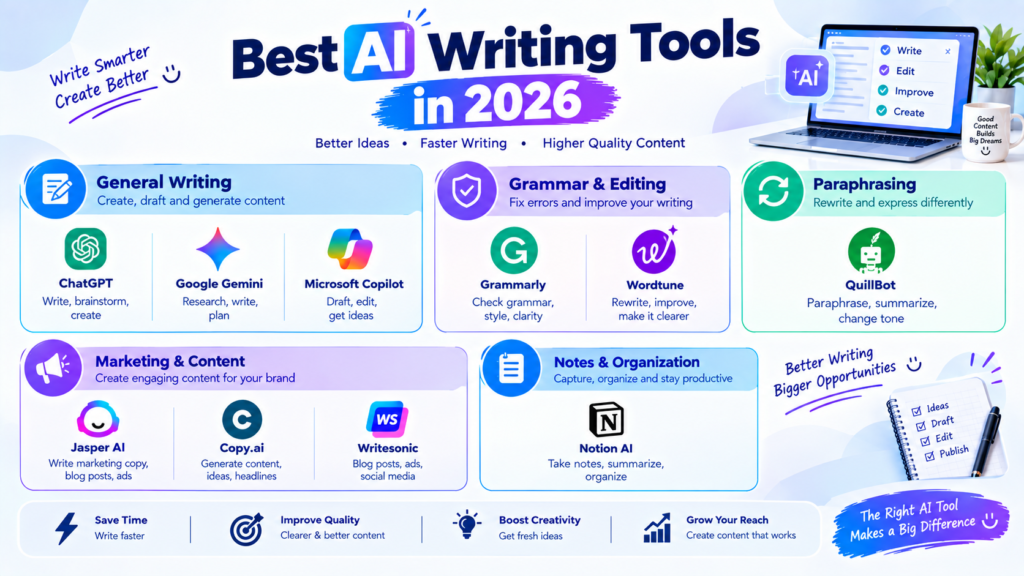
Here are some popular AI writing tools that can be useful for different types of writing.
1. ChatGPT
ChatGPT is a general-purpose AI assistant that can also be used as a powerful writing tool. It can help users brainstorm ideas, create outlines, draft content, rewrite paragraphs, summarize text, and improve writing.
You can give ChatGPT a specific instruction and ask it to adjust the tone, structure, or length of your content.
For example, you can ask it to:
- Create a blog outline
- Rewrite an introduction
- Explain difficult writing
- Generate article ideas
- Improve an email
- Create social media content
- Summarize a long document
One of its biggest advantages is flexibility because it can support many different writing tasks.
2. Grammarly
Grammarly is widely used for grammar and writing improvement. It can help identify grammatical mistakes, spelling errors, punctuation issues, and other writing problems.
It is especially useful for people who already have a draft but want to improve its clarity and correctness.
Students, professionals, bloggers, and businesses can use grammar-checking tools to make their writing more polished.
3. QuillBot
QuillBot focuses heavily on rewriting and paraphrasing. It can help users rewrite sentences while maintaining the original meaning.
It can be useful when you want to:
- Rephrase sentences
- Improve readability
- Create alternative versions
- Summarize text
- Fix awkward wording
QuillBot can be particularly useful during the editing stage of the writing process.
4. Jasper AI
Jasper AI is designed with content marketing and business writing in mind. It can assist with creating marketing copy, blog content, product descriptions, advertisements, and other business-related content.
Businesses and marketing teams can use AI writing tools like Jasper to speed up content production and generate ideas.
However, generated content should still be reviewed and edited to match the company’s brand voice and goals.
5. Copy.ai
Copy.ai is another AI-powered writing platform that focuses on business and marketing content.
It can help with tasks such as:
- Marketing copy
- Social media content
- Sales content
- Product descriptions
- Email content
- Business writing
It can be useful for marketers who need to create multiple pieces of content regularly.
6. Microsoft Copilot
Microsoft Copilot can assist users with writing and productivity tasks across Microsoft’s ecosystem.
It can help draft, rewrite, summarize, and organize information depending on the Microsoft application and features available to the user.
For people who already work with Microsoft products, an integrated AI assistant can make writing and document-related tasks more convenient.
7. Google Gemini
Google Gemini can also be used for many writing tasks. It can help generate ideas, create drafts, summarize information, rewrite text, and assist with research-oriented writing.
It can be useful for students, professionals, content creators, and anyone who regularly works with written information.
As with other AI tools, users should review generated information and make sure the final content is accurate.
8. Notion AI
Notion AI combines writing assistance with notes and organization. It can help users create, edit, summarize, and organize information inside their workspace.
For example, users can use AI to turn notes into a more structured document or summarize information from a larger page.
It can be particularly useful for people who already use Notion for project management, planning, documentation, or personal organization.
9. Writesonic
Writesonic is designed around AI-powered content creation and can help with different types of marketing and web content.
It can be useful for bloggers, marketers, and businesses that need help creating content ideas, drafts, advertisements, and other written material.
The quality of AI-generated content depends heavily on the instructions provided and the amount of editing performed afterward.
10. Wordtune
Wordtune focuses on improving and rewriting existing writing. Instead of always generating an entire document, users can use it to make individual sentences clearer and more natural.
It can be useful when you want to:
- Rewrite a sentence
- Change the tone
- Make text shorter
- Make writing clearer
- Improve readability
This makes it useful during the editing process.
Best AI Writing Tools for Different Needs
Not every AI writing tool is designed for the same purpose. Choosing one based on your specific task can make your workflow more efficient.
For General Writing
ChatGPT, Google Gemini, and Microsoft Copilot can help with a wide range of writing tasks, from brainstorming to drafting and editing.
For Grammar and Editing
Grammarly and Wordtune can be useful for improving existing writing and identifying areas that need correction or refinement.
For Paraphrasing
QuillBot is designed around rewriting and paraphrasing, making it useful when you need alternative wording.
For Marketing Content
Jasper, Copy.ai, and Writesonic can help marketers and businesses create different types of promotional content.
For Notes and Organization
Notion AI can be useful for people who want writing assistance combined with notes and workspace organization.
How to Choose the Right AI Writing Tool
Before choosing an AI writing tool, consider what you actually need.
1. Identify Your Main Writing Task
Are you writing blog posts, emails, essays, advertisements, or business documents? Different tools may be better suited to different tasks.
2. Check the Editing Features
If your main goal is improving existing writing, look for tools that provide grammar, rewriting, tone, and clarity features.
3. Consider Ease of Use
A tool should be easy to understand and fit naturally into your existing workflow.
4. Check Free and Paid Features
Many AI writing platforms offer free plans with limitations and paid plans with additional features. Check the current plan details before subscribing.
5. Think About Your Workflow
If you already use tools such as Microsoft Office, Google Workspace, or Notion, an AI assistant that works within your existing workflow may be more convenient.
How to Use AI Writing Tools Effectively
AI can make writing easier, but the quality of the result depends on how you use it.
Give Clear Instructions
Instead of saying:
“Write something about AI.”
Give a more specific instruction:
“Create a 1,500-word beginner-friendly article about how AI tools can improve productivity. Use simple English and include practical examples.”
Clear instructions usually produce more useful results.
Provide Context
Tell the AI who the content is for, what tone you want, and what information should be included.
Always Review the Output
Never assume that AI-generated content is automatically correct. Review facts, names, statistics, and important claims before publishing or submitting content.
Add Your Own Ideas
AI should help support your creativity. Adding your own examples, experiences, opinions, and explanations can make content more useful and original.
Edit Before Publishing
A generated draft is not necessarily a finished article. Read it carefully and improve its structure, accuracy, flow, and originality.
Can AI Replace Human Writers?
AI writing tools can automate many parts of the writing process, but human judgment remains important.
AI can help generate text quickly, but humans are responsible for deciding what information matters, checking accuracy, understanding the audience, and adding meaningful ideas.
For professional content, the best approach is often to combine AI assistance with human editing.
Think of AI as a writing assistant rather than a complete replacement for the writer.
Tips for Better AI Writing Results
Here are some practical tips for getting better results from AI writing tools:
- Start with a clear goal.
- Give detailed prompts.
- Specify your target audience.
- Mention the desired writing style.
- Ask for an outline before a long article.
- Break large tasks into smaller steps.
- Review AI-generated information.
- Add original examples and ideas.
- Edit the final content yourself.
- Avoid publishing unreviewed AI output.
Final Thoughts
The best AI writing tools in 2026 can make writing faster, easier, and more organized. Tools such as ChatGPT, Grammarly, QuillBot, Jasper AI, Copy.ai, Microsoft Copilot, Google Gemini, Notion AI, Writesonic, and Wordtune can support different parts of the writing process.
The best option depends on your specific needs. Some tools are better for general writing, while others focus on grammar, paraphrasing, marketing content, or organization.
The most effective way to use AI writing software is to combine artificial intelligence with human creativity and editing. Use AI to generate ideas, create drafts, and improve your workflow, but always review the final content before publishing or submitting it.
Writing is an important part of many daily tasks. Students write assignments and essays, bloggers create articles, businesses prepare emails and marketing content, and professionals write reports, proposals, and documents. In 2026, artificial intelligence has made many of these writing tasks faster and easier.
AI writing tools can help users generate ideas, improve grammar, rewrite sentences, summarize information, create outlines, and produce different types of content. However, these tools work best when they are used as assistants rather than complete replacements for human writers.
In this guide, we will explore some of the best AI writing tools in 2026, their main features, and how they can help with different writing tasks.
What Are AI Writing Tools?
AI writing tools are software applications that use artificial intelligence to help people create or improve written content. They can understand instructions, analyze text, suggest improvements, and generate new content based on a user’s prompt.
Depending on the tool, you can use AI writing software for:
- Blog posts
- Articles
- Emails
- Essays
- Social media posts
- Product descriptions
- Business documents
- Grammar correction
- Rewriting
- Summarization
- Content ideas
- Headlines and titles
The right tool depends on your writing goals and the type of content you create.
Why Use AI Writing Tools in 2026?
AI writing tools have become useful for both beginners and experienced writers. They can reduce the time required for repetitive writing tasks and help users overcome writer’s block.
1. Save Time
AI can quickly create outlines, drafts, summaries, and ideas. This allows writers to spend more time editing and improving their final content.
2. Improve Grammar
Many AI writing assistants can identify spelling, grammar, punctuation, and sentence-structure problems.
3. Generate Ideas
If you do not know what to write about, AI can suggest topics, headlines, questions, and content angles.
4. Rewrite Content
AI tools can rewrite sentences to make them clearer, shorter, more professional, or easier to understand.
5. Improve Productivity
Instead of starting every document from a blank page, writers can use AI to create a first draft and then improve it themselves.
Best AI Writing Tools in 2026
Here are some popular AI writing tools that can be useful for different types of writing.
1. ChatGPT
ChatGPT is a general-purpose AI assistant that can also be used as a powerful writing tool. It can help users brainstorm ideas, create outlines, draft content, rewrite paragraphs, summarize text, and improve writing.
You can give ChatGPT a specific instruction and ask it to adjust the tone, structure, or length of your content.
For example, you can ask it to:
- Create a blog outline
- Rewrite an introduction
- Explain difficult writing
- Generate article ideas
- Improve an email
- Create social media content
- Summarize a long document
One of its biggest advantages is flexibility because it can support many different writing tasks.
2. Grammarly
Grammarly is widely used for grammar and writing improvement. It can help identify grammatical mistakes, spelling errors, punctuation issues, and other writing problems.
It is especially useful for people who already have a draft but want to improve its clarity and correctness.
Students, professionals, bloggers, and businesses can use grammar-checking tools to make their writing more polished.
3. QuillBot
QuillBot focuses heavily on rewriting and paraphrasing. It can help users rewrite sentences while maintaining the original meaning.
It can be useful when you want to:
- Rephrase sentences
- Improve readability
- Create alternative versions
- Summarize text
- Fix awkward wording
QuillBot can be particularly useful during the editing stage of the writing process.
4. Jasper AI
Jasper AI is designed with content marketing and business writing in mind. It can assist with creating marketing copy, blog content, product descriptions, advertisements, and other business-related content.
Businesses and marketing teams can use AI writing tools like Jasper to speed up content production and generate ideas.
However, generated content should still be reviewed and edited to match the company’s brand voice and goals.
5. Copy.ai
Copy.ai is another AI-powered writing platform that focuses on business and marketing content.
It can help with tasks such as:
- Marketing copy
- Social media content
- Sales content
- Product descriptions
- Email content
- Business writing
It can be useful for marketers who need to create multiple pieces of content regularly.
6. Microsoft Copilot
Microsoft Copilot can assist users with writing and productivity tasks across Microsoft’s ecosystem.
It can help draft, rewrite, summarize, and organize information depending on the Microsoft application and features available to the user.
For people who already work with Microsoft products, an integrated AI assistant can make writing and document-related tasks more convenient.
7. Google Gemini
Google Gemini can also be used for many writing tasks. It can help generate ideas, create drafts, summarize information, rewrite text, and assist with research-oriented writing.
It can be useful for students, professionals, content creators, and anyone who regularly works with written information.
As with other AI tools, users should review generated information and make sure the final content is accurate.
8. Notion AI
Notion AI combines writing assistance with notes and organization. It can help users create, edit, summarize, and organize information inside their workspace.
For example, users can use AI to turn notes into a more structured document or summarize information from a larger page.
It can be particularly useful for people who already use Notion for project management, planning, documentation, or personal organization.
9. Writesonic
Writesonic is designed around AI-powered content creation and can help with different types of marketing and web content.
It can be useful for bloggers, marketers, and businesses that need help creating content ideas, drafts, advertisements, and other written material.
The quality of AI-generated content depends heavily on the instructions provided and the amount of editing performed afterward.
10. Wordtune
Wordtune focuses on improving and rewriting existing writing. Instead of always generating an entire document, users can use it to make individual sentences clearer and more natural.
It can be useful when you want to:
- Rewrite a sentence
- Change the tone
- Make text shorter
- Make writing clearer
- Improve readability
This makes it useful during the editing process.
Best AI Writing Tools for Different Needs
Not every AI writing tool is designed for the same purpose. Choosing one based on your specific task can make your workflow more efficient.
For General Writing
ChatGPT, Google Gemini, and Microsoft Copilot can help with a wide range of writing tasks, from brainstorming to drafting and editing.
For Grammar and Editing
Grammarly and Wordtune can be useful for improving existing writing and identifying areas that need correction or refinement.
For Paraphrasing
QuillBot is designed around rewriting and paraphrasing, making it useful when you need alternative wording.
For Marketing Content
Jasper, Copy.ai, and Writesonic can help marketers and businesses create different types of promotional content.
For Notes and Organization
Notion AI can be useful for people who want writing assistance combined with notes and workspace organization.
How to Choose the Right AI Writing Tool
Before choosing an AI writing tool, consider what you actually need.
1. Identify Your Main Writing Task
Are you writing blog posts, emails, essays, advertisements, or business documents? Different tools may be better suited to different tasks.
2. Check the Editing Features
If your main goal is improving existing writing, look for tools that provide grammar, rewriting, tone, and clarity features.
3. Consider Ease of Use
A tool should be easy to understand and fit naturally into your existing workflow.
4. Check Free and Paid Features
Many AI writing platforms offer free plans with limitations and paid plans with additional features. Check the current plan details before subscribing.
5. Think About Your Workflow
If you already use tools such as Microsoft Office, Google Workspace, or Notion, an AI assistant that works within your existing workflow may be more convenient.
How to Use AI Writing Tools Effectively
AI can make writing easier, but the quality of the result depends on how you use it.
Give Clear Instructions
Instead of saying:
“Write something about AI.”
Give a more specific instruction:
“Create a 1,500-word beginner-friendly article about how AI tools can improve productivity. Use simple English and include practical examples.”
Clear instructions usually produce more useful results.
Provide Context
Tell the AI who the content is for, what tone you want, and what information should be included.
Always Review the Output
Never assume that AI-generated content is automatically correct. Review facts, names, statistics, and important claims before publishing or submitting content.
Add Your Own Ideas
AI should help support your creativity. Adding your own examples, experiences, opinions, and explanations can make content more useful and original.
Edit Before Publishing
A generated draft is not necessarily a finished article. Read it carefully and improve its structure, accuracy, flow, and originality.
Can AI Replace Human Writers?
AI writing tools can automate many parts of the writing process, but human judgment remains important.
AI can help generate text quickly, but humans are responsible for deciding what information matters, checking accuracy, understanding the audience, and adding meaningful ideas.
For professional content, the best approach is often to combine AI assistance with human editing.
Think of AI as a writing assistant rather than a complete replacement for the writer.
Tips for Better AI Writing Results
Here are some practical tips for getting better results from AI writing tools:
- Start with a clear goal.
- Give detailed prompts.
- Specify your target audience.
- Mention the desired writing style.
- Ask for an outline before a long article.
- Break large tasks into smaller steps.
- Review AI-generated information.
- Add original examples and ideas.
- Edit the final content yourself.
- Avoid publishing unreviewed AI output.
Final Thoughts
The best AI writing tools in 2026 can make writing faster, easier, and more organized. Tools such as ChatGPT, Grammarly, QuillBot, Jasper AI, Copy.ai, Microsoft Copilot, Google Gemini, Notion AI, Writesonic, and Wordtune can support different parts of the writing process.
The best option depends on your specific needs. Some tools are better for general writing, while others focus on grammar, paraphrasing, marketing content, or organization.
The most effective way to use AI writing software is to combine artificial intelligence with human creativity and editing. Use AI to generate ideas, create drafts, and improve your workflow, but always review the final content before publishing or submitting it.